Babe Ruth rookie card: key RCs, checklist and collector interest
Babe Ruth's first base rookie card is the 1916 Sporting News M101-4 #151. Babe Ruth's rookie season was 1914.
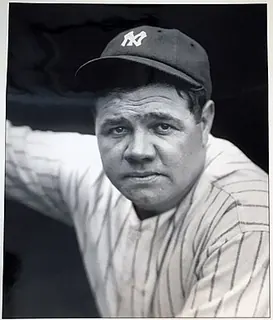
Babe Ruth card market
Collector attention: down 14% this week, down 9% over 30 days
Attention measures how much people are looking up this player, a leading indicator collectors watch. It is not a price. Source: Wikipedia pageviews through 2026-10-15.
Babe Ruth's key rookie cards, by our criteria
- First licensed base RC: The licensed base rookie card from the earliest year in the player's checklist. Where an Upper Deck Young Guns card exists, that card.
- First chromium RC: The licensed chromium (Chrome, Prizm, Optic and the like) rookie card from the earliest year in the player's checklist.
- Scarcest licensed RC autograph: Among licensed rookie-card autographs in the player's checklist, the one with the lowest stated print run.
- First prospect card: For a player whose rookie cards are not out yet, or a baseball player's Bowman 1st: the earliest prospect card in the player's checklist. Not a rookie card.
Which Babe Ruth card is the real rookie card
Ruth signed with the minor-league Baltimore Orioles in early 1914 and debuted with the Boston Red Sox that July. His earliest card, the 1914 Baltimore News #9, shows him as an Oriole and is described as a pre-rookie card. Collectors treat the two 1916 Sporting News cards, M101-4 #151 and M101-5 #151 (catalog codes from the American Card Catalog), as his accepted rookie cards. None of these were licensed in the modern sense; they were newspaper and premium issues, so the licensed field is left null.
Advertisement
Babe Ruth rookie card checklist with card numbers
2 rookie cards and 1 earlier or related card, each confirmed on the linked pages. Not every parallel is listed.
Babe Ruth's career, in brief
- Played 22 seasons, 1914 to 1935, for the Boston Red Sox (1914 to 1919), New York Yankees (1920 to 1934) and Boston Braves (1935).
- 714 career home runs with a .342 career batting average.
- Won seven World Series: 1915, 1916 and 1918 with Boston and 1923, 1927, 1928 and 1932 with New York.
- One of the first five players elected to the Hall of Fame, in 1936, with 95.1 percent of the vote.
Career facts: [1]
- Played from 1914 to 1935.
- Honors include the Major League Baseball Most Valuable Player Award, the Major League Baseball All-Star, the Boston Red Sox Hall of Fame, among 6 listed on Wikidata.
Advertisement
Record public Babe Ruth card sales
Reported sales only, each with the report that carried it.
- 2013-09: 1916 Sporting News M101-5, EX+, sold for $98,175 at Memory Lane Inc. (2013 Summer Auction). Sports Collectors Digest
Grading Babe Ruth cards
A PSA 10 (Gem Mint) or BGS 9.5 is the top grade most collectors look for; it means sharp corners, clean edges, centered printing and an unmarked surface. A graded card and a raw one are different cards to look up.
- 1917 Collins-McCarthy E135 #147 (not a rookie card): thin, glossy stock that wears and cracks (source: oldsportscards.com).
Sources [1]
How PSA, CGC and Beckett grade
PSA
- Top grades:
- Gem Mint 10, then Mint 9 and NM-MT 8.
- Half grades:
- 1.5 through 8.5 since February 2008; there is no PSA 9.5.
One overall grade on the label. Centering weighs heavily in it.
CGC
- Top grades:
- Pristine 10 (virtually flawless, 50/50 centering), then Gem Mint 10 and Mint+ 9.5.
- Half grades:
- Yes, from Fair 1.5 up to Mint+ 9.5.
Authentic (AU) for a genuine card that cannot take a number; Authentic Altered (AA) for one that was altered.
Source: CGC grading scale
Beckett (BGS)
- Top grades:
- Pristine 10; a Black Label Pristine 10 has a 10 in all four subgrades.
- Half grades:
- Yes, 1 to 10 in half points.
Four subgrades on the label: centering, corners, edges and surface.
Source: Beckett grading
Grading scales as each grader describes them, checked Oct 16, 2026.
Population by grade
A population report counts how many copies of a card a grader has graded at each grade. Search 1916 Sporting News M101-4 #151 on PSA Population Report or CGC Cards Population Report.
How to identify your Babe Ruth card and check what it sold for
- Find the year and maker on the back of your Babe Ruth card, and the card number, usually top or bottom on the back.
- Check the front and back for a serial number (for example 23/99) and for a colored or patterned finish: those mark a parallel, which is a different card from the base version.
- Look for the RC logo or the word Rookie. A card from before the first pro season, such as a Bowman 1st or a college card, is a prospect card, not a rookie card.
- Note any grade on the slab label (PSA, BGS, SGC, CGC). A raw card and a graded one are different listings.
- Search sold listings for that exact year, set, number, parallel and grade. What a card sold for is a better guide than any asking price.
Check Babe Ruth rookie cards in eBay's sold listings or eBay's price guide for that exact card.
Babe Ruth cards for sale now
Babe Ruth card questions
- What is Babe Ruth's rookie card?
- Babe Ruth's first base rookie card is the 1916 Sporting News M101-4 #151. Babe Ruth's rookie season was 1914.
- What year is Babe Ruth's rookie card?
- Babe Ruth's rookie season was 1914, so the rookie cards carry that year.
- How many rookie cards does Babe Ruth have?
- Our checklist lists 2 Babe Ruth rookie cards with card numbers, each from a cited source. It is not every parallel or color variation.
- How much is a Babe Ruth rookie card worth?
- Parlae does not print card values. Find the year, set, card number, parallel and grade on your card, then check eBay sold listings or eBay's price guide for that exact card.
- Are collectors watching Babe Ruth right now?
- Collector attention is flat: Wikipedia lookups of Babe Ruth are down 14% this week. That is attention, not a price.
More from Parlae
Card facts checked 2026-10-15. Parlae prints no card values. Set and brand names belong to their makers; Parlae is not affiliated with them.
By the Parlae deskCard data updated Oct 16, 2026 at 8:34 AM ETHow this is builtReport a wrong number