Hank Aaron rookie card: key RCs, checklist and collector interest
Hank Aaron's first base rookie card is the 1954 Topps #128. Hank Aaron's rookie season was 1954.
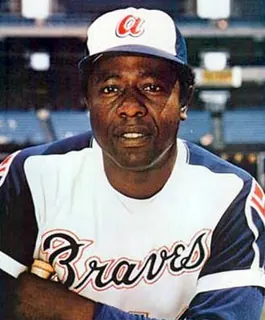
Hank Aaron card market
Collector attention: up 18% this week, up 9% over 30 days
Attention measures how much people are looking up this player, a leading indicator collectors watch. It is not a price. Source: Wikipedia pageviews through 2026-10-15.
Hank Aaron's key rookie cards, by our criteria
- First licensed base RC: The licensed base rookie card from the earliest year in the player's checklist. Where an Upper Deck Young Guns card exists, that card.
- First chromium RC: The licensed chromium (Chrome, Prizm, Optic and the like) rookie card from the earliest year in the player's checklist.
- Scarcest licensed RC autograph: Among licensed rookie-card autographs in the player's checklist, the one with the lowest stated print run.
- First prospect card: For a player whose rookie cards are not out yet, or a baseball player's Bowman 1st: the earliest prospect card in the player's checklist. Not a rookie card.
Which Hank Aaron card is the real rookie card
Aaron debuted with the Milwaukee Braves in April 1954, and 1954 Topps #128 is his only recognized mainstream rookie card. He also appears in two 1954 regional Braves issues, Johnston Cookies #5 (which the guide also calls his rookie card) and Spic and Span #1. Cards of this era were made under contracts with individual players, not a league-wide license, so the licensed field is left null.
Advertisement
Hank Aaron rookie card checklist with card numbers
2 rookie cards and 1 earlier or related card, each confirmed on the linked pages. Not every parallel is listed.
Hank Aaron's career, in brief
- Played 23 seasons, 1954 to 1976, for the Milwaukee and Atlanta Braves (1954 to 1974) and the Milwaukee Brewers (1975 to 1976).
- 755 career home runs, 2,297 RBI and 3,771 hits.
- 1957 NL MVP and 1957 World Series champion with the Milwaukee Braves.
- Elected to the Hall of Fame in 1982, his first year of eligibility, with 97.8 percent of the vote.
Career facts: [1]
- Played from 1954 to 1976.
- Honors include the Spingarn Medal, the Presidential Citizens Medal, the Rawlings Gold Glove Award, among 12 listed on Wikidata.
Advertisement
Record public Hank Aaron card sales
Reported sales only, each with the report that carried it.
- 2013-09: 1954 Topps #128, PSA 9, sold for $36,023 at Memory Lane Inc. (2013 Summer Auction). Sports Collectors Digest
Grading Hank Aaron cards
A PSA 10 (Gem Mint) or BGS 9.5 is the top grade most collectors look for; it means sharp corners, clean edges, centered printing and an unmarked surface. A graded card and a raw one are different cards to look up.
How PSA, CGC and Beckett grade
PSA
- Top grades:
- Gem Mint 10, then Mint 9 and NM-MT 8.
- Half grades:
- 1.5 through 8.5 since February 2008; there is no PSA 9.5.
One overall grade on the label. Centering weighs heavily in it.
CGC
- Top grades:
- Pristine 10 (virtually flawless, 50/50 centering), then Gem Mint 10 and Mint+ 9.5.
- Half grades:
- Yes, from Fair 1.5 up to Mint+ 9.5.
Authentic (AU) for a genuine card that cannot take a number; Authentic Altered (AA) for one that was altered.
Source: CGC grading scale
Beckett (BGS)
- Top grades:
- Pristine 10; a Black Label Pristine 10 has a 10 in all four subgrades.
- Half grades:
- Yes, 1 to 10 in half points.
Four subgrades on the label: centering, corners, edges and surface.
Source: Beckett grading
Grading scales as each grader describes them, checked Oct 16, 2026.
Population by grade
A population report counts how many copies of a card a grader has graded at each grade. Search 1954 Topps #128 on PSA Population Report or CGC Cards Population Report.
How to identify your Hank Aaron card and check what it sold for
- Find the year and maker on the back of your Hank Aaron card, and the card number, usually top or bottom on the back.
- Check the front and back for a serial number (for example 23/99) and for a colored or patterned finish: those mark a parallel, which is a different card from the base version.
- Look for the RC logo or the word Rookie. A card from before the first pro season, such as a Bowman 1st or a college card, is a prospect card, not a rookie card.
- Note any grade on the slab label (PSA, BGS, SGC, CGC). A raw card and a graded one are different listings.
- Search sold listings for that exact year, set, number, parallel and grade. What a card sold for is a better guide than any asking price.
Check Hank Aaron rookie cards in eBay's sold listings or eBay's price guide for that exact card.
Hank Aaron cards for sale now
Hank Aaron card questions
- What is Hank Aaron's rookie card?
- Hank Aaron's first base rookie card is the 1954 Topps #128. Hank Aaron's rookie season was 1954.
- What year is Hank Aaron's rookie card?
- Hank Aaron's rookie season was 1954, so the rookie cards carry that year.
- How many rookie cards does Hank Aaron have?
- Our checklist lists 2 Hank Aaron rookie cards with card numbers, each from a cited source. It is not every parallel or color variation.
- How much is a Hank Aaron rookie card worth?
- Parlae does not print card values. Find the year, set, card number, parallel and grade on your card, then check eBay sold listings or eBay's price guide for that exact card.
- Are collectors watching Hank Aaron right now?
- Collector attention is rising: Wikipedia lookups of Hank Aaron are up 18% this week. That is attention, not a price.
More from Parlae
Card facts checked 2026-10-15. Parlae prints no card values. Set and brand names belong to their makers; Parlae is not affiliated with them.
By the Parlae deskCard data updated Oct 16, 2026 at 8:34 AM ETHow this is builtReport a wrong number